
Local SEO for taxi companies starts with accurate operator information, clear pickup coverage, and a reliable way to arrange a ride. A passenger should be able to identify the company, understand whether it can handle the trip, and find out what happens after calling or submitting a request.
Review three things first: whether the business is represented correctly, whether its website answers practical trip questions, and whether requests reach someone who can respond. More listings or location pages will not resolve an unanswered phone or an unclear booking process.
This guide covers those checks for taxi operators and the teams maintaining their websites. It does not assume that every company offers airport pickups, round-the-clock rides, wheelchair-accessible vehicles, or instant online confirmation. Before including any of these services on the website, ask the person responsible for operations to confirm what passengers can actually arrange.
Establish What the Company Actually Provides
Prepare a short operational record before editing profiles or writing pages. Ask the person responsible for dispatch to confirm:
- The operating name and the business responsible for accepting rides.
- Locations where pickups can be arranged, including any restrictions.
- Destinations served and whether return pickups are available.
- How passengers request, change, or cancel a trip.
- When the phone is answered and when rides can be fulfilled.
- Vehicle options, passenger capacity, and luggage limitations.
- How fares or estimates are communicated, including applicable conditions.
- Which services require advance arrangements.
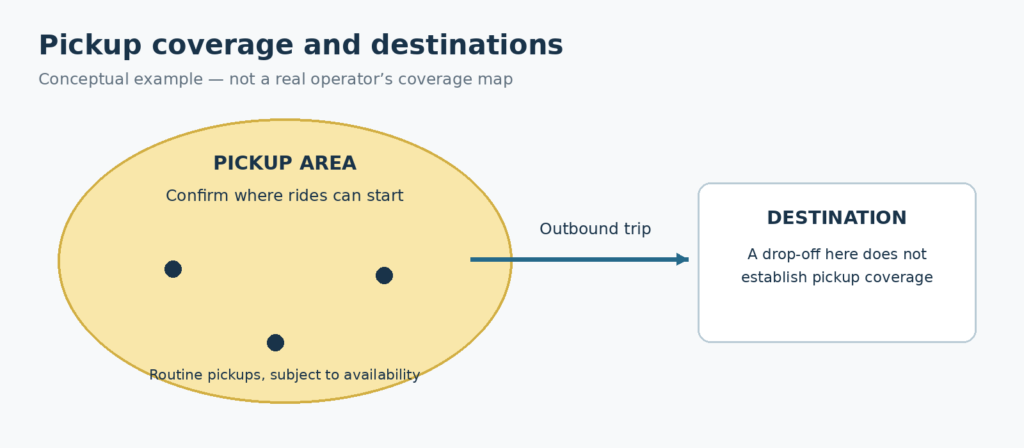
Separate pickup coverage from destinations. A company might take passengers to an airport without accepting pickups from that airport. Treating both as the same service can leave passengers with incorrect expectations.
Use this record to resolve contradictions across the website, public profiles, and dispatch instructions. If a statement cannot be confirmed, leave it out until someone responsible can verify it.
Check Business Profile Eligibility and Ownership
A taxi operator that travels to customers may qualify for a Google Business Profile. A website that only collects enquiries and passes them to unrelated operators is a different business model: Google’s eligibility guidance excludes lead-generation agents or companies and online-only businesses.
Confirm which business the profile represents before creating or changing one. Check whether a profile already exists, who controls it, and whether the owner can manage access. Avoid creating a second listing simply because an old login is unavailable; investigate access to the existing profile first.
Keep the business owner involved in account control. Record who can update the profile and who will remove access when an employee or outside provider stops working with the company.
Represent the Operator Accurately
Use Google’s business representation guidelines when checking the profile. The name should reflect the real business; categories should describe its core activity. Do not add city names or promotional phrases solely to influence visibility. Check that the listed phone connects to the business and remains under its control.
Review these details together rather than correcting each field in isolation:
| Profile detail | What to verify |
|---|---|
| Name and category | They describe the operator and its actual primary service. |
| Phone and website | A passenger reaches the intended company through a working route. |
| Address and service area | The setup reflects how the company serves customers. |
| Description and images | Statements and photographs represent services and vehicles genuinely available. |
Handle Addresses and Hours Carefully
An administrative address is not automatically a customer-facing office. Check the service-area rules before displaying it. Do not describe a mailing address as a staffed place where passengers can visit.
Hours need particular care. Google’s guidance lists transportation services among businesses that should not provide standard business hours. Review that exception before applying generic advice to mark a taxi profile as open 24 hours.
On the website, distinguish telephone availability, online request availability, and ride availability. A form that accepts submissions overnight does not mean a dispatcher will immediately respond or a vehicle is available.
Describe Service Areas Without Creating False Coverage
Google distinguishes service-area businesses from hybrid businesses that also receive customers at their premises. Under Google’s service-area guidance, an operator that travels to passengers without receiving customers at its premises should keep that address hidden on its profile.
On the website, explain coverage in terms a passenger can use. State where pickups are arranged and whether particular trips require advance confirmation. Avoid broad claims such as serving an entire state if the company cannot reliably accept those requests.
Airport destinations, hotel drop-offs, and long-distance journeys should not automatically become claims of routine pickup coverage in those places. Confirm the actual arrangement with dispatch.
Check What a Separate Location Page Would Explain
Before creating another location page, identify the trip information it would add beyond the main coverage page. That might involve specific pickup arrangements, service limitations, or genuinely different trip options.
If the only difference is a place name, revise the main coverage page instead. A series of nearly identical pages gives the business more information to maintain without necessarily explaining anything new.
Review existing service area pages for details that help passengers arrange a pickup in the place described, and confirm those details with dispatch. Do not invent offices, drivers based in a neighborhood, or completed trips to make the page appear more local.
Build Website Pages Around Passenger Decisions
Plan pages around information the operator can provide reliably. The following roles are options, not a requirement to create six separate pages.
| Page or section | Information it should resolve |
|---|---|
| Main taxi service | What the company offers, where pickups are available, and how to arrange a ride. |
| Airport service | Which arrangements are available and what passengers need to confirm. |
| Coverage | Pickup areas, destinations, restrictions, and advance-booking requirements. |
| Vehicles | Verified capacity, luggage space, and available vehicle features. |
| Booking or contact | Required trip details, response expectations, and confirmation steps. |
| Fares | How the price is determined and which conditions affect an estimate. |
Make the title and main heading specific enough to distinguish the page from the company’s other pages. State the service and relevant area clearly, then explain the practical details. Repeating the city in every heading does not provide additional trip information.
Check That Important Pages Can Be Found
Open the main service and coverage pages without signing in. Confirm that they load successfully, contain the intended service information, and can be reached through normal website links. Ask the website administrator to investigate unintended crawler restrictions, indexing exclusions, or canonical settings that point to a different page.
Canonical settings help indicate the preferred URL when similar versions of a page exist. A setting that points elsewhere should be checked against the site’s intended structure rather than removed automatically.
Google’s technical requirements explain the minimum conditions for search eligibility. Meeting those conditions does not guarantee indexing or a particular position.
Explain Airport Arrangements Precisely
Before describing an airport pickup service, confirm that the operator can provide it and check the airport’s current official instructions where applicable. Do not imply an airport partnership, permission, or dedicated pickup position without evidence.
Where relevant, explain whether advance booking is required, how the meeting point is confirmed, what flight details are needed, and who the passenger should contact after a delay. Clarify waiting arrangements and any charges before the passenger commits.
Avoid writing permanent instructions for arrangements that can change. Assign someone to review the page when the airport or operator changes its pickup procedure.
Describe Vehicle Options Without Ambiguity
Use actual fleet information. Confirm passenger capacity, luggage constraints, and whether a particular vehicle type must be requested in advance.
Do not use a photograph of a specialist vehicle as evidence that the company provides that service. For accessibility-related requests, explain the features the operator can confirm and provide a way to discuss individual requirements before booking.
Record these facts and the person approving them in a website content brief so later revisions do not introduce unsupported services or promises.
Test the Route From Search to a Confirmed Ride
Review the entire contact process with dispatch. A working button is only the beginning; the company also needs a reliable way to receive, assess, and respond to the request.
Check Calls and Mobile Use
Open the website on a phone and test the main call link. Confirm the displayed number and the number dialed are correct. Check that navigation, pop-ups, or other elements do not obscure the contact options.
Arrange a test call with the business. Verify who receives it, what happens when it is unanswered, and whether the recorded message accurately explains the next step. Test any separate airport or campaign numbers too.
Use the result to correct the actual problem. A page cannot promise immediate assistance if the company has no process for responding at that time.
Check Online Requests Through to Receipt
Submit an agreed test request and follow it through to the inbox or dispatch system. Confirm that the recipient can see the passenger’s contact details and enough trip information to respond.
Check pickup and destination fields, date and time, and any required passenger or luggage information. Where time zones could be ambiguous, label the requested time clearly. For airport trips, distinguish a flight arrival time from the requested pickup time.
Make the submission message match the operational process. If dispatch must review availability, say the request has been received and explain how confirmation will follow. Do not label an unreviewed enquiry a confirmed reservation.
Use the website contact form checklist for a deeper review of form behavior, errors, delivery, and follow-up. Keep private passenger information out of public testing notes and screenshots.
Keep Public Listings and Business Evidence Accurate
Review the public listings the company already uses before opening more accounts. Correct obsolete contact details, services no longer offered, and links to retired pages.
Consider additional directories only when they serve a relevant audience and allow an accurate business entry. A genuine local transport directory may have a purpose; a bulk package of unrelated listings is not a substitute for checking where passengers can actually find useful information.
Use photographs the business owns or has permission to publish. Check that fleet images remain representative. Remove or update claims about vehicles, facilities, credentials, or memberships that cannot be substantiated.
Keep responsibility for updates clear. A change to the phone number, operating name, or booking system should trigger a review of the places where that information appears.
Request Reviews Without Steering the Outcome
Google’s Maps contribution policy requires genuine experiences and prohibits incentives for reviews and selective solicitation of positive reviews. It also addresses conflicts of interest, including employee relationships.
Ask for honest feedback without tying the request to a discount or telling passengers what words to include. Do not direct satisfied passengers to a public review page while sending dissatisfied passengers only to a private form.
Review responses should address the concern without exposing trip details, phone numbers, pickup addresses, or other personal information. If resolving a complaint requires checking a passenger’s booking, continue through a private contact channel instead of discussing the record in a public reply.
Measure Visibility Separately From Completed Bookings
Google describes local results in terms of relevance, distance, and prominence, and says there is no way to request or pay for a better local ranking in its local ranking guidance. Accurate information supports a useful listing, but it does not establish a guaranteed position.
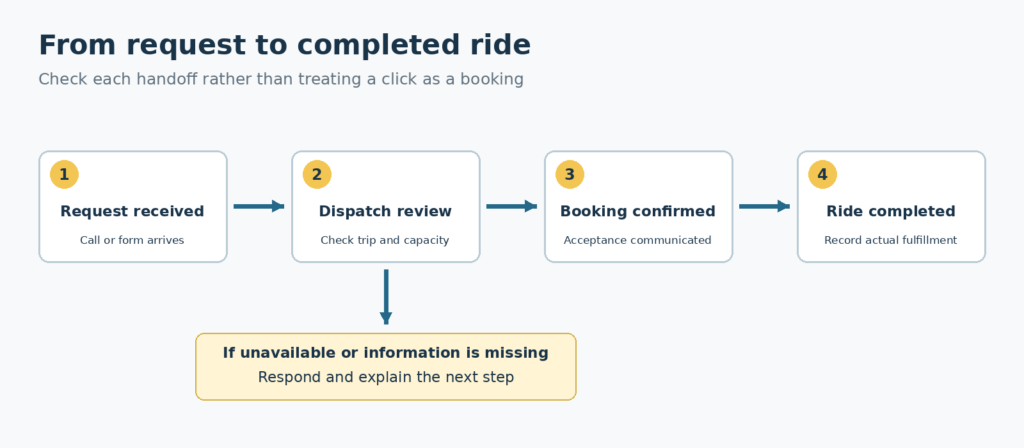
For operational decisions, separate what happens at each stage:
| Stage | What to record or investigate |
|---|---|
| Discovery | Whether the company is being seen through the available reporting. |
| Contact | Calls or requests received through the contact routes being measured. |
| Dispatch review | Whether dispatch has enough trip details to check availability and respond. |
| Acceptance | Whether the company confirms it can provide the trip. |
| Fulfillment | Whether the accepted ride is completed. |
Keep the definitions attached to each measure. Google’s Business Profile performance documentation defines its Calls metric as clicks on the profile’s call button. It does not establish how many calls were answered or became bookings.
Business Profile performance can include activity from organic results and Google Ads, and available metrics vary by business. When the business also runs Google Ads, check which activity the report includes before interpreting its totals as results from unpaid local visibility. Similarly, a website button click should not automatically be recorded as a completed reservation.
Where practical, compare contact reporting with dispatch records using a process appropriate for the business and its privacy obligations. Record uncertainty when the source of a booking cannot be determined. Do not manufacture attribution to make a channel appear more effective.
Diagnose the Stage That Needs Attention
Use observations to choose what to investigate. The following are starting points, not proof of a particular cause.
| Observation | Investigation to start with |
|---|---|
| Passengers ask whether the company serves an area already listed online. | Check whether pickup coverage and destinations are clearly distinguished. |
| Calls are attempted but few reach dispatch. | Test number routing, answering arrangements, and reporting definitions. |
| Requests arrive without usable trip information. | Review form fields, labels, and receipt in the dispatch system. |
| Many requests cannot be accepted. | Compare advertised coverage, availability, and vehicle options with actual capacity. |
| Confirmed trips are difficult to trace in reports. | Review the connection between contact records, confirmation, and completed rides. |
Prioritize Corrections Before Expanding Content
Work through issues in an order that protects the passenger’s ability to arrange a real trip:
- Correct a wrong number, broken contact route, or request-delivery failure.
- Resolve inaccurate business identity, address, or service claims.
- Clarify pickup coverage, availability, and confirmation expectations.
- Fix missing trip details and unclear fare information.
- Investigate technical problems affecting important website pages.
- Improve measurement so contact attempts and completed rides remain distinct.
- Add a new page only when an unanswered passenger need justifies it.
For each correction, record the issue, the person responsible, and how the change will be checked. A contact-route fix needs a completed test. A coverage change needs approval from someone who knows which trips the operator can accept.
Repeat the review after material changes such as a new booking system, a revised pickup area, or a change to the fleet. Choose a routine review schedule the company can maintain rather than allowing outdated information to accumulate.
Local SEO Review Checklist for Taxi Companies
- The listed business is the actual operator and has been checked for profile eligibility.
- The owner can access the profile and manage outside contributors.
- Name, category, phone, and website accurately represent the company.
- Address visibility and profile hours have been reviewed against the applicable guidance.
- Pickup areas are distinguished from destinations and conditional trip arrangements.
- Location pages contain useful differences rather than substituted place names.
- Airport, vehicle, accessibility, and availability statements have an operational basis.
- Important website pages load and can be reached through ordinary links.
- Phone links and online requests have been tested through to receipt.
- Passengers can distinguish a submitted request from a confirmed booking.
- Review requests are neutral and reporting keeps contact attempts separate from completed rides.
- Each correction has an owner and a way to verify it.
The useful outcome is a consistent path from finding the company to arranging a ride it can provide. Improve that path before adding more locations, listings, or articles.