
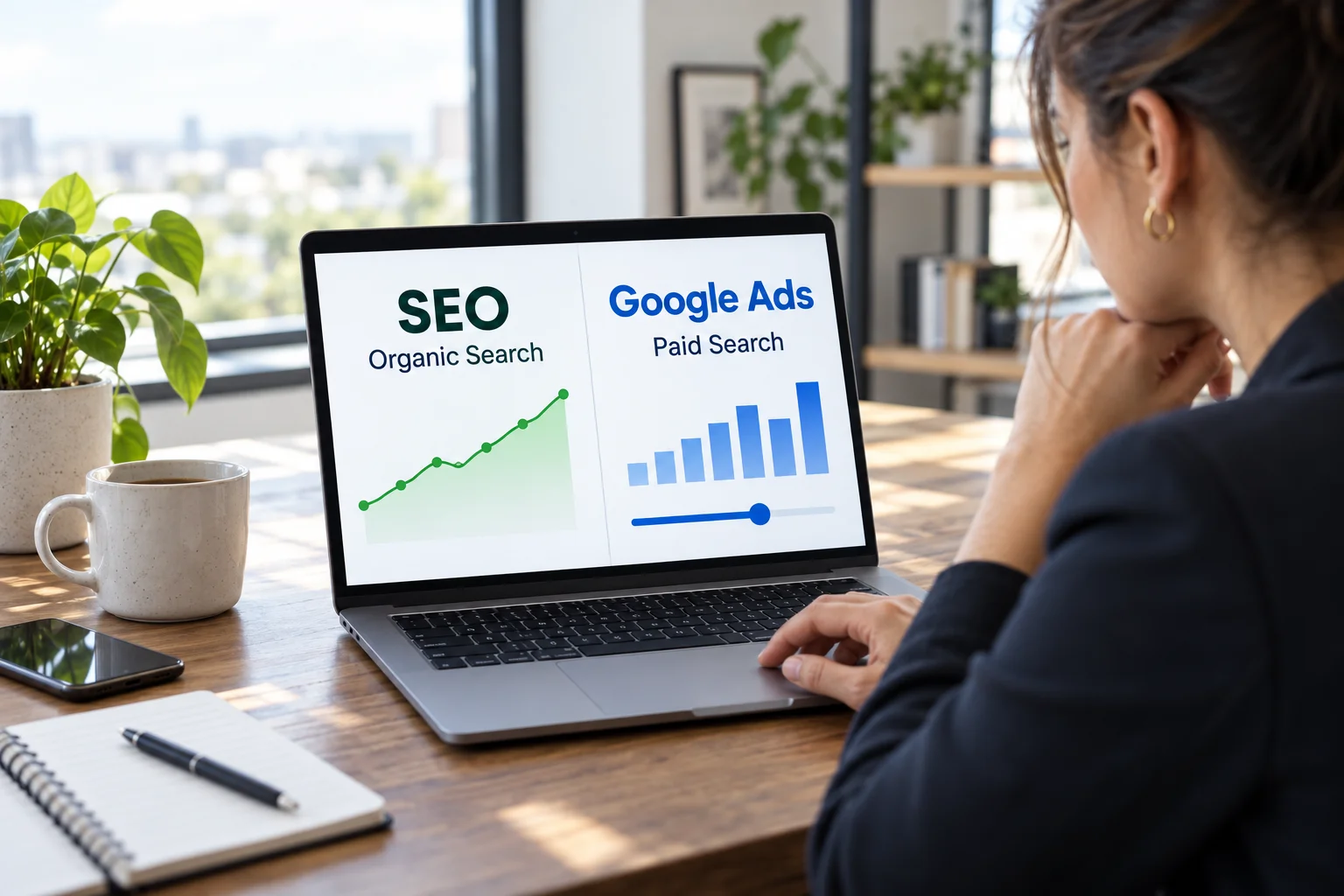
SEO vs Google Ads for small businesses is not a choice between a universally better and worse channel. Google Ads may be more suitable when a business needs immediate, controlled visibility and has a tested offer, sufficient budget, and reliable conversion tracking. SEO is usually better suited to building organic visibility around services and customer questions over time.
Some businesses need one channel first. Others benefit from using both for different purposes. The right decision depends on timing, customer demand, website readiness, margins, and the business’s ability to measure enquiries or sales.
SEO and Google Ads Solve Different Problems
SEO improves a website’s ability to appear in unpaid search results. The work can include technical improvements, service-page development, useful supporting content, internal linking, and clearer information about the business.
Google Ads allows an advertiser to compete for paid placements. Search ads enter an auction when an eligible search occurs. Google considers factors that include the bid, the quality and relevance of the ad and landing page, the search context, ad thresholds, and available assets. Paying the highest bid alone does not guarantee the leading position.
Google’s explanation of SEO and PPC also makes an important distinction: advertising through Google Ads does not improve a website’s organic rankings.
| Consideration | SEO | Google Ads |
| Placement | Organic search results | Paid advertising placements |
| Speed of visibility | Requires crawling, indexing and competitive evaluation | Can begin after the campaign and ads become eligible |
| Direct media cost | No charge for an organic click | Advertising cost applies according to the campaign model |
| Ongoing work | Technical, content and website improvements | Budget, targeting, ads, bidding and campaign management |
| Control | Limited control over rankings and snippets | Greater control over budget, targeting and advertising messages |
| Visibility after work stops | Existing pages may continue appearing, but performance can change | Ads normally stop serving when the campaign or funding stops |
| Measurement | Search visibility, clicks, engagement and qualified outcomes | Spend, clicks, conversions, conversion value and acquisition cost |
| Best initial use | Building useful long-term search coverage | Reaching active demand for a defined offer |
SEO is not free simply because organic clicks do not carry an advertising charge. Research, writing, development, maintenance and specialist support can still require time and money.
Google Ads is not instant revenue. It can make an eligible advertisement visible quickly, but a click only brings someone to the website. The offer, landing page, pricing, credibility and enquiry process determine what happens next.
Choose Google Ads When Timing Matters
Google Ads may be the more practical starting point when the business needs to reach potential customers during a defined period.
Examples include:
- Launching a new service with a clear landing page
- Promoting an offer with a genuine deadline
- Filling short-term appointment or project capacity
- Testing demand in a specific location
- Reaching people searching for a high-intent service
- Collecting initial evidence about offers and search language
Advertisers can set an average daily campaign budget and adjust bidding according to their objectives. Actual participation and placement depend on the auction. Google explains that a campaign’s budget establishes its spending limit and should reflect an amount the advertiser is comfortable spending.
Immediate visibility is useful only when the business is prepared for it. Before paying for traffic, confirm that:
- The advertised service is clearly defined.
- The landing page matches the advertisement.
- Pricing or the factors affecting cost are understandable.
- The website provides credible and accurate business information.
- The contact form or purchase process works.
- Calls, forms, purchases or other valuable actions can be measured.
- Someone can respond to enquiries within a reasonable period.
Sending paid traffic to an incomplete service page makes it difficult to judge whether the problem is the campaign, the offer or the website.
Choose SEO When the Business Needs a Stronger Search Foundation
SEO may deserve priority when customers repeatedly research the same services, questions and comparisons, but the website does not yet provide useful pages for those searches.
This is common when a business has:
- Thin or unclear service pages
- Important pages missing from search
- Several services combined on one unfocused page
- Weak navigation or internal linking
- Outdated articles
- Duplicate location pages
- Technical barriers affecting crawling or indexing
- Useful expertise that has not been presented online
SEO work should begin with commercially important pages rather than an arbitrary publishing schedule. A service page should explain the offer, suitable customers, process, limitations, service coverage and next step. Supporting articles can then answer questions that would make the service page unnecessarily long.
Businesses planning this work can review Glorvix’s SEO services to understand how technical review, page planning, on-page improvements and content opportunities can fit into one scope.
SEO offers less control over timing. Search engines decide whether to crawl, index and rank a page. Changes may need time to be discovered and evaluated, and strong competitors may already satisfy the search well. No responsible provider can guarantee a specific organic position or deadline.
Compare the Decision Against the Customer Journey
The choice becomes clearer when it is connected to an actual customer journey.
Consider a small accounting firm that wants more enquiries for a defined bookkeeping service.
The firm may use Google Ads to reach people currently searching for that service within its genuine coverage area. The campaign can direct those users to a focused bookkeeping page.
At the same time, SEO work may improve that service page and create supporting resources addressing questions such as:
- What records should a business prepare?
- How does monthly bookkeeping differ from year-end accounting?
- What affects the cost of bookkeeping?
- When should a small business seek professional help?
The advertisements address immediate visibility. The organic pages create a stronger information base for future discovery. They support different stages of the same customer decision.
This is an illustrative example, not a claim about results for a particular firm.
Calculate Whether Paid Acquisition Is Financially Viable
A business should not select Google Ads based only on the available daily budget. It needs to understand what a customer is worth and how often enquiries become customers.
Useful inputs include:
- Average revenue from a customer
- Direct cost of delivering the product or service
- Gross contribution from the sale
- Percentage of qualified leads that become customers
- Existing sales and administrative costs
- Repeat purchases or retention, where reliably measured
- Refunds, cancellations and unqualified enquiries
Suppose a hypothetical service produces $2,000 in contribution before advertising and general overhead. If one in four qualified leads becomes a customer, the expected contribution per qualified lead would be:
$2,000 × 25% = $500
That does not mean the business should willingly pay $500 for every lead. Other operating costs, risk and the desired profit must still be considered. It provides a boundary for evaluating acquisition costs rather than choosing a budget without reference to business economics.
The same discipline applies to SEO. Divide the cost of content, technical work and ongoing maintenance by the qualified outcomes influenced by organic search. Do not evaluate either channel solely by impressions or rankings.
Make Sure Conversion Tracking Is Ready
Advertising decisions become unreliable when the business cannot distinguish valuable outcomes from ordinary clicks.
Before launching a campaign, define the conversion:
- Completed enquiry form
- Qualified phone call
- Confirmed booking
- Completed purchase
- Trial registration
- Another action closely connected to business value
A button click is not always a completed inquiry. A submitted form is not always a qualified lead. Where practical, review the eventual quality of enquiries rather than reporting every initial action as an equal success.
Google Ads supports conversion measurement for actions that matter to an advertiser. Campaigns using automated bidding may also use conversion information to inform bid decisions. Poor configuration can therefore affect both reporting and optimization.
Test the complete process before launch. Submit the form, confirm delivery, check the confirmation message and verify that the intended event is recorded once.
Check Whether the Landing Page Is Ready for Advertising
A suitable Google Ads landing page should continue the promise made in the advertisement. Someone searching for one service should not be sent to a general homepage that requires them to find it again.
Review the page for:
- A heading that clearly identifies the service or offer
- An explanation of what is included
- Accurate location or availability information
- Genuine contact and business details
- A clear next action
- Mobile usability
- Appropriate loading performance
- Working forms, telephone links and email links
- Privacy information where personal data is collected
The page does not need aggressive sales language. It needs enough clarity for a suitable visitor to understand the offer and decide what to do next.
Businesses preparing paid search campaigns can review the scope of Google Ads management when considering campaign structure, landing-page alignment and measurement.
Use Google Ads as a Research Input, Not an SEO Shortcut
Paid-search data can reveal useful information about search terms, advertisements and landing pages, but it should be interpreted carefully.
A term that receives clicks through an advertisement does not automatically deserve a new SEO page. First determine:
- Whether the search represents a relevant customer need
- Whether the traffic produced qualified outcomes
- Whether an existing page already satisfies the topic
- What type of organic result Google shows for the query
- Whether the business can contribute useful information
- Whether the demand is stable or tied to one promotion
Likewise, an organic query with impressions does not automatically belong in an advertising campaign. Informational searches may be valuable for education while being unsuitable for paid acquisition.
The two channels can exchange evidence without being treated as the same system.
When SEO Should Come First
Prioritize SEO and website improvements before advertising when:
- The website does not clearly explain its services.
- Important pages are inaccessible or not indexable.
- The contact process is broken.
- The business has not defined its audience or service coverage.
- The same generic page would receive every advertisement.
- The available budget is too limited to generate meaningful evidence.
- No one can measure or respond to enquiries.
- The business needs to correct inaccurate information or unsupported claims.
Advertising can expose these weaknesses more quickly, but it cannot repair them.
When Google Ads Should Come First
Google Ads may come first when:
- The website and landing page are ready.
- The offer is already understood by customers.
- Search demand has clear commercial intent.
- The business needs visibility for a defined period.
- A profitable service has additional capacity.
- The target locations are accurately defined.
- Conversion tracking has been tested.
- The business can afford a controlled learning period without expecting every click to convert.
Start with a focused campaign rather than advertising every service at once. A narrow scope makes it easier to identify whether the targeting, advertisement, landing page or offer needs improvement.
When Using Both Is the Better Decision
SEO and Google Ads can work together when the business has the resources to manage each channel properly.
A practical division might be:
- Use Google Ads for high-intent searches connected to a focused landing page.
- Use SEO to strengthen core service pages and answer recurring customer questions.
- Use paid-search information to identify wording and objections worth investigating.
- Use organic landing-page data to identify pages that may support advertising.
- Evaluate both channels using qualified business outcomes.
Keep reporting separate enough to understand what produced each visit and conversion. Do not attribute organic ranking improvements to advertising spend without evidence.
A Practical Decision Checklist
Answer these questions before choosing a channel:
- Do we need visibility immediately, or can we build it progressively?
- Is there a complete page for the service we want to promote?
- Can we identify the searches used by suitable customers?
- Do we know what a qualified lead or sale is worth?
- Can we track completed conversions accurately?
- Can we afford paid testing without depending on immediate profitability?
- Do we have expertise that can become genuinely useful organic content?
- Are technical problems limiting existing pages?
- Can someone maintain the selected channel?
- What evidence will cause us to continue, change or stop the activity?
If the business needs immediate demand and has a prepared landing page, Google Ads may be the logical first test. If the website lacks useful commercial pages and a reliable search foundation, SEO should normally come first. If both needs exist and resources permit, assign each channel a distinct role.
Frequently Asked Questions
Does paying for Google Ads improve organic SEO rankings?
No. Google states that advertising does not improve a website’s organic rankings. Paid and organic search visibility use separate systems.
Is SEO cheaper than Google Ads?
Not necessarily. Organic clicks do not have a direct advertising charge, but SEO can require research, content, technical work, development and maintenance. The useful comparison is cost per qualified business outcome, measured over an appropriate period.
Can a small business run SEO and Google Ads together?
Yes, provided each channel has a defined purpose and sufficient resources. Google Ads can address immediate high-intent demand while SEO develops service pages and supporting content.
Should a new website begin with advertising?
Only when its offer, landing pages, contact process and tracking are ready. A new website with incomplete service information may benefit more from fixing its foundation first.
Which channel produces faster visibility?
Google Ads can provide visibility after a campaign and its ads become eligible to serve. SEO changes depend on crawling, indexing, relevance, competition and search-engine evaluation, so their timing is less controllable.
Choose the Channel That Matches the Immediate Constraint
The right starting point depends on what currently prevents growth.
If the problem is a lack of immediate visibility for a proven offer, a controlled Google Ads campaign may provide useful evidence. If the problem is an unclear, incomplete or technically weak website, SEO and page improvements should receive priority.