
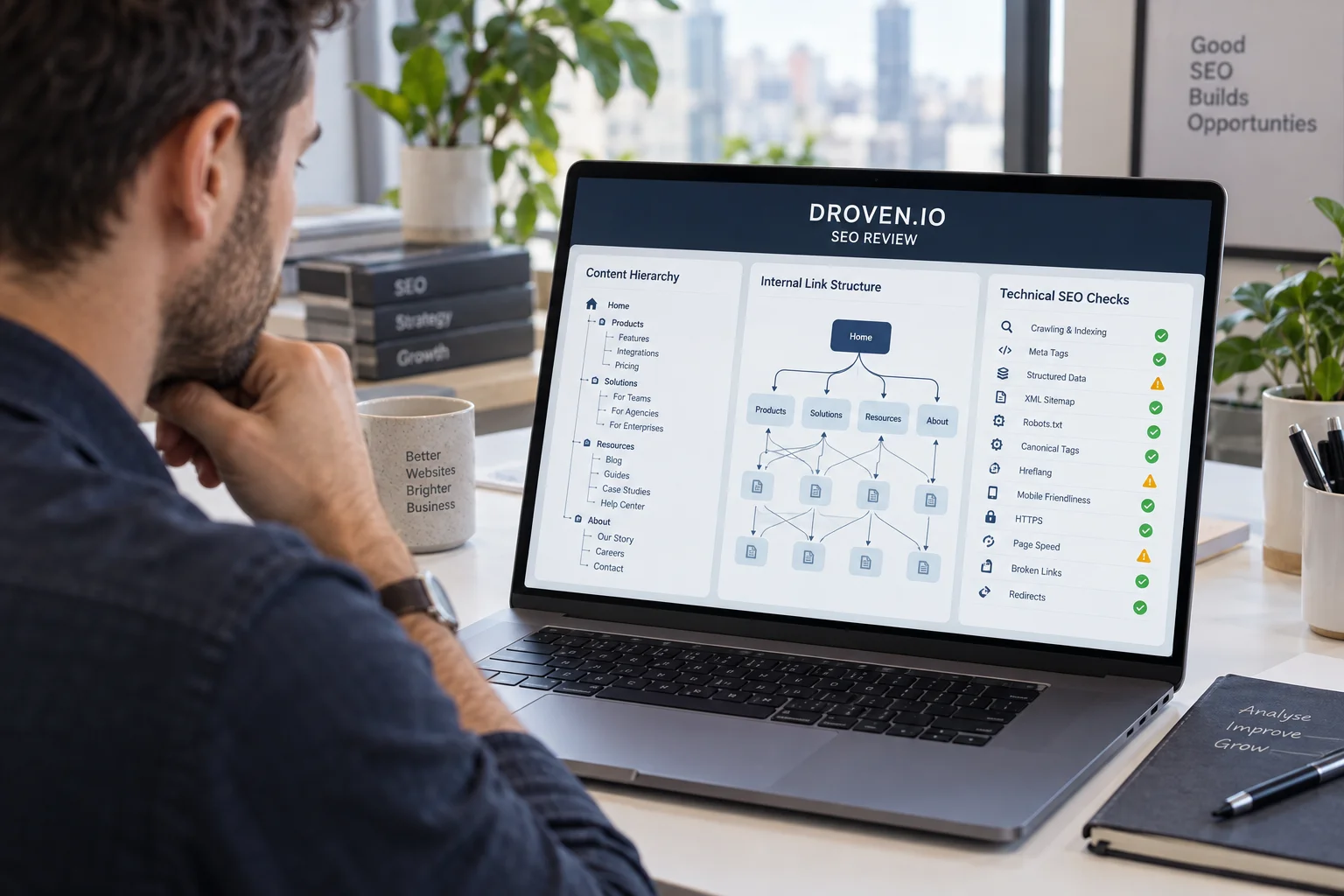
Droven.io is an editorial publishing website focused mainly on artificial intelligence, technology, software development and digital transformation. It is not presented on its public website as an AI tool, automation product or software-as-a-service platform.
From a public SEO perspective, the site has a recognizable subject area, a large body of content and several useful topic hubs. The main concern visible in this public review is topical focus: broad and sometimes loosely related articles appear across overlapping categories, which makes the site’s editorial identity and topical structure less clear than it could be.
This review does not indicate that Droven.io has received a search penalty or that every identified concern is affecting rankings. It examines only publicly accessible pages and highlights improvements that may make the site easier for readers and search engines to understand.
What Is Droven.io?
Droven.io describes itself as an editorial source covering artificial intelligence, generative AI, the future of work and business innovation. Its homepage contains sections for AI tools, AI in business, digital transformation, big data, information technology, technology reviews and related subjects.
That public presentation supports describing Droven.io as a technology publisher or knowledge website. Visitors should not assume that it operates its own AI model, automation system or software product unless a separate product page provides evidence of that service.
This distinction matters for search intent. Someone searching for Droven.io may be trying to identify the website, understand what it publishes or determine whether it provides a usable AI tool. The homepage should answer that question immediately and consistently.
Scope and Limitations of This SEO Review
This independent review is based on publicly accessible pages and external observations. Glorvix has no affiliation with Droven.io and does not have access to its Google Search Console, analytics account, content-management system, hosting environment, server logs or private business records.
The review can therefore assess:
- Public positioning and navigation
- Visible headings, page titles and content organization
- Category structure and internal links
- Author and contact information shown to readers
- The relationship between published topics and the site’s stated focus
It cannot confirm:
- Indexing coverage inside Google Search Console
- Manual actions or algorithmic causes of traffic changes
- Conversion or engagement data
- Server-level crawling problems
- The accuracy of private traffic or revenue claims
- Complete canonical, redirect and log-file behavior across every URL
Any full technical audit would need appropriate access and a controlled crawl of the complete website.
Droven.io SEO Findings at a Glance
| Area | Public observation | Assessment |
| Site identity | The homepage identifies Droven.io as an AI, technology and digital-transformation editorial source | Clear at a general level |
| Content format | The site publishes articles rather than offering a visible AI software interface | Clear |
| Topic coverage | AI, software, cloud, cybersecurity, business, product reviews and other subjects are covered | Broad |
| Navigation | Numerous categories and subcategories are available from the main menu and footer | Useful but complex |
| Category alignment | Some articles appear only loosely connected with the category or the site’s central promise | Needs review |
| Internal anchors | A navigation link uses the phrase “droven.io cloud computing guide” instead of a simpler descriptive label | Could be more natural |
| Editorial contact | A contact page, email addresses, privacy policy and terms links are visible | Positive foundation |
| Editorial identity | Public author names such as “adminde” provide limited information about responsibility or expertise | Could be clearer |
| Technical status | Public pages and article content are accessible in ordinary web retrieval | Positive but not a complete audit |
The Site Has a Clear Theme, but Its Positioning Is Too Wide
Artificial intelligence is the strongest theme on the homepage. Dedicated sections cover generative AI, AI tools, AI in business and automation. Technology, software development, cloud computing, cybersecurity and data analysis can all fit naturally around that central subject.
The difficulty appears when the site extends beyond that framework. Publicly visible sections also include articles about pool systems, sprinkler maintenance, roulette, betting markets, industrial equipment, investment advisers and cryptocurrency reward claims. Some of those subjects may involve technology or business at a broad level, but that connection is not always apparent from the title or category placement.
This does not automatically make the pages low quality. It does, however, create an information-architecture problem. A reader arriving for AI guidance may struggle to understand why unrelated consumer, gambling, financial or industrial subjects are part of the same editorial promise.
Droven.io would benefit from defining a narrower rule for publication. A topic should either belong directly to AI and enterprise technology or have a clearly explained connection with digital transformation. Content that cannot meet that standard may be better placed on a more suitable publication.
Category Overlap Makes Navigation Harder to Interpret
The primary navigation includes broad labels such as AI, Technology, Digital, Reviews, Blog and Droven. Those sections then contain several subcategories, including Artificial Intelligence, AI Tools & Applications, AI in Business & Marketing, Information Technology, Tech, Software Development, Digital Transformation and AI Business Processes.
Several of these labels can reasonably contain the same article. For example, a guide about an AI marketing platform could belong to AI Tools, AI in Business, Digital Transformation, Tech Reviews or the general Blog archive. Without clear editorial rules, overlapping categories can produce an inconsistent archive structure and make internal-link priorities difficult to determine.
The “Droven” navigation item is particularly unclear because it opens a category archive rather than an About page. Readers may interpret the brand name as a route to company or publication information. A descriptive label such as “Latest,” “Features” or “Editorial” would communicate the destination more accurately. An actual About page could then explain the publisher’s purpose, ownership, editorial standards and review process.
A simpler structure could use four main content hubs:
- Artificial Intelligence
- Business Technology
- Software and Development
- Reviews and Comparisons
Subcategories should be retained only where the site has enough distinct, closely related content to justify a separate archive.
Some Navigation Labels Appear Written for Keywords
The link text “droven.io cloud computing guide” appears in prominent navigation areas. It describes the destination, but it reads more like an exact search query than a normal menu label.
“Cloud Computing” would be clearer for readers and would still describe the category accurately. The destination page already uses a descriptive heading covering AWS, Azure and Google Cloud, so the brand-plus-keyword construction is unnecessary.
Internal anchors should help a visitor predict what will open next. Repeating a target phrase in navigation does not provide additional value when a shorter label communicates the same meaning.
Homepage Organization Creates Competing Priorities
The homepage provides many routes into the site, which helps expose deeper content. It also presents a large number of sections, categories and article cards. AI appears to be the primary subject, but later sections give similar visual importance to general technology, digital transformation, big data, future-of-work content, reviews and the broadly defined Droven category.
This volume can weaken the homepage hierarchy. A stronger structure would establish:
- What Droven.io is
- Which audience it serves
- Its three or four principal subject areas
- The most useful or recently updated articles within those areas
- Its editorial and review standards
Reducing competing sections would not require removing useful content. It would give the most important topics more prominence and reduce the number of decisions facing a new visitor.
Article Quality Is Uneven at the Topic Level
Some recent articles address specific and relevant questions, such as deployment security for AI-built applications, AI visibility tracking and the use of AI agents in inventory management. These subjects fit the site’s stated direction.
Other articles use strong numerical or financial language in their titles. Numerical claims can be valuable, but they require a clearly identifiable original source, correct context and wording that does not imply more certainty than the evidence supports. Financial, security and product-review content needs particularly careful sourcing because readers may use it to make consequential decisions.
Each article should pass an editorial check covering:
- Whether its subject belongs on the site
- Whether the title accurately represents the evidence
- Whether statistics link to an original or authoritative source
- Whether commercial relationships are disclosed
- Whether product experience is genuinely firsthand
- Whether advice is separated from verified fact
- Whether an article substantially overlaps an existing page
Google Search Essentials advises publishers to create helpful, reliable, people-first content, while Google’s guidance for high-quality reviews favors original research and evidence of genuine evaluation over thin summaries. These principles support fewer, better-defined articles rather than expanding every keyword variation into a separate page.
Editorial Transparency Could Be Stronger
Droven.io provides a contact page and displays contact details. The page also invites collaboration and guest-post inquiries, while privacy and terms links appear in the footer. These elements give readers a way to contact the publication and form a useful foundation for transparency.
The visible author identity is less informative. Names such as “adminde” do not tell readers who researched or reviewed an article. That matters most for technical, cybersecurity, financial and product-review subjects.
Useful improvements would include:
- A clear About page linked from the main navigation
- Named author pages with concise, verifiable biographies
- An editorial policy explaining sourcing and corrections
- A review methodology for tool comparisons
- Visible disclosure where content is sponsored, contributed or commercially connected
- A corrections contact or process
These additions would not prove that every article is accurate, but they would help readers understand who is responsible for the content and how it is produced.
What Cannot Be Determined From the Public Website Alone
A page can look technically sound in a browser while still having problems elsewhere. A complete investigation should separately verify:
- XML sitemap coverage and accuracy
- Robots directives
- Canonical tags across posts, archives and paginated pages
- Redirect chains and broken internal links
- Duplicate titles and descriptions
- Thin tag, author and category archives
- Orphaned articles
- Mobile Core Web Vitals using field data where available
- Structured-data validity and eligibility
- Image dimensions, compression and lazy loading
- Crawl frequency and wasted crawl activity in server logs
These are recommended audit checks, not confirmed faults on Droven.io. They should not be reported as existing problems without test results.
For businesses that need this deeper level of investigation, a structured SEO service should combine a site crawl with search-performance data and manual review rather than relying on a single score.
Priority Improvements for Droven.io
1. Define the editorial boundary
Keep content centered on AI, software, digital operations and closely related business technology. Review articles that do not have a clear connection with that purpose.
2. Simplify the taxonomy
Merge overlapping categories and assign each article one primary content home. Use secondary tags sparingly and only where they improve discovery.
3. Clarify brand and publication information
Replace the ambiguous “Droven” category link in the primary menu with a clearly labeled destination, and add a dedicated About page if one is not already available elsewhere.
4. Replace keyword-shaped navigation text
Change “droven.io cloud computing guide” to a natural label such as “Cloud Computing.” Reserve longer phrases for page titles and explanatory copy where they fit grammatically.
5. Strengthen editorial accountability
Use identifiable author profiles, sourcing standards, disclosure language and a corrections process, especially for reviews and high-impact claims.
6. Complete a crawler-based technical audit
Use Search Console, analytics, a full crawl and server information to confirm indexation, canonicalization, redirect and performance issues before making technical changes.
Is Droven.io Good From an SEO Perspective?
Droven.io has several useful SEO foundations: its public pages are accessible, the homepage communicates an AI and technology theme, articles are organized into topic areas, and important contact and policy links are visible.
The larger concern is coherence. The number of overlapping categories and the presence of loosely related subjects make it harder to identify the publication’s central expertise. Natural navigation labels, a tighter editorial boundary, clearer authorship and a simplified hub structure would improve both reader understanding and topical consistency.
No responsible public review can determine whether the domain is penalized, how much organic traffic it receives or whether every technical directive is correct without private data and a complete crawl. The defensible conclusion is narrower: Droven.io is an active editorial publisher with a visible AI and technology focus, but its public content architecture and editorial signals leave meaningful room for improvement.