

A website refresh is worth considering when the existing site still supports the business and the problems can be addressed through focused changes. A redesign becomes more appropriate when several connected problems require a different page structure, customer journey or set of templates.
Start with the problem you need to solve. Outdated service information, confusing navigation, a failed contact form and an unsuitable publishing platform require different responses. The age or appearance of the website alone does not establish which project is necessary.
This guide explains how to compare website refresh vs redesign, assess the evidence and define a scope that addresses the actual problem.
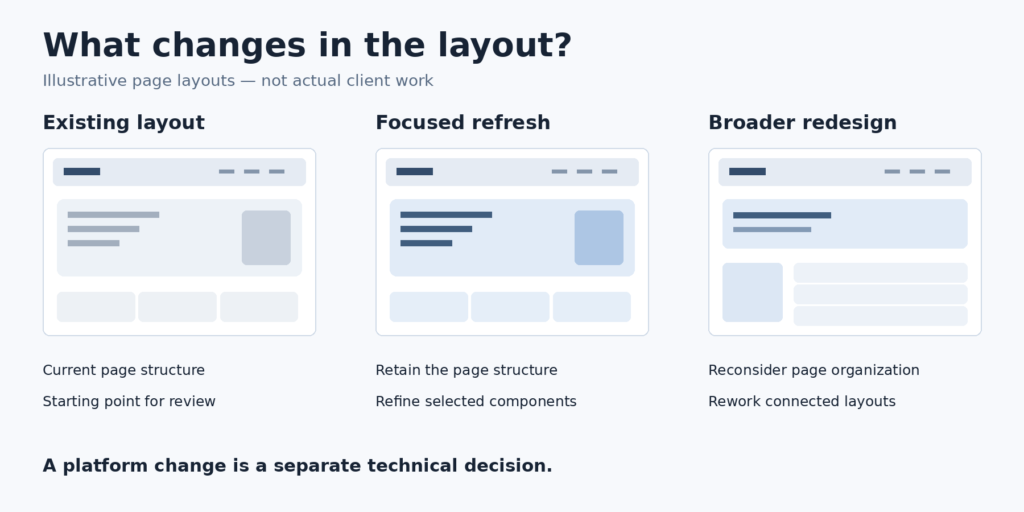
What Changes in a Refresh or Redesign?
Use the following working distinctions when discussing a project. Ask suppliers to describe their deliverables, because a project name alone does not tell you what will change.
| Decision area | Focused website refresh | Broader website redesign |
|---|---|---|
| Main purpose | Improve selected parts of a website that remains suitable | Rework connected parts that no longer support the business |
| Page organization | Mostly retained, with specific adjustments | Reviewed and potentially reorganized |
| Content | Selected information, messages or pages updated | Page roles and content requirements reconsidered more broadly |
| Design | Existing layouts refined or selected components replaced | Shared templates and visual direction may be replaced |
| Functionality | Specific defects or requirements addressed | Important workflows may be reworked |
| Platform | Retained if it supports the agreed changes | Retained or replaced according to technical requirements |
| Testing | Changed components and affected journeys | New templates, journeys and affected systems |
A refresh can involve development work. It does not have to be limited to colors, fonts or images.
Similarly, a redesign does not automatically require a new domain, hosting provider or content management system. A content management system, or CMS, is the software used to create and maintain website content. Decide whether it needs replacement separately from the visual design.
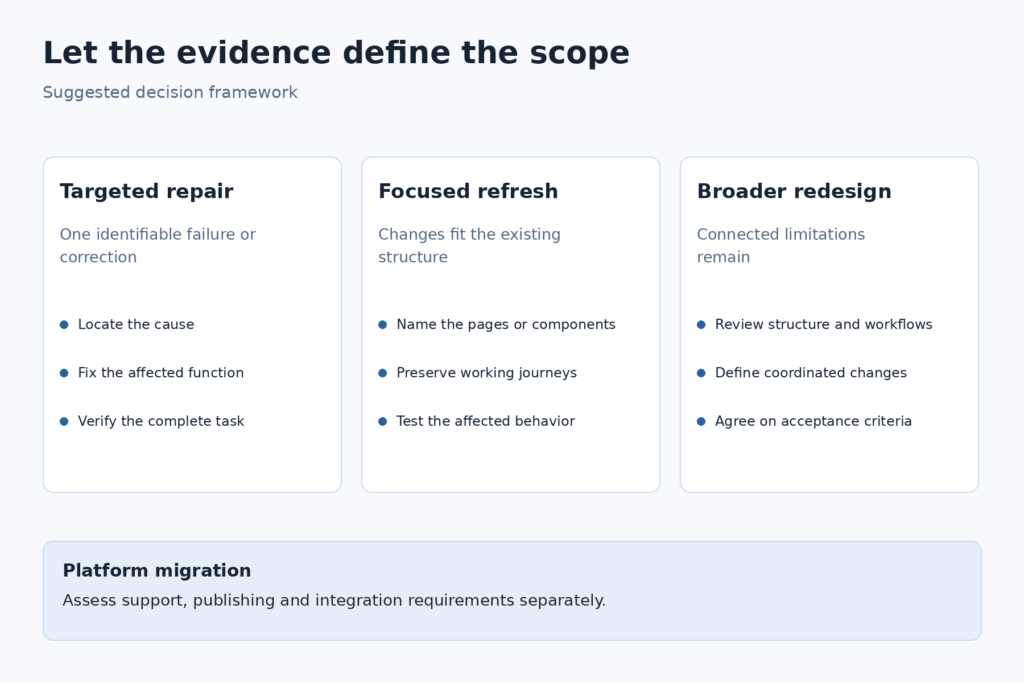
There is also a third possibility: a targeted repair or routine content update may be sufficient. A broken notification route does not, by itself, justify replacing an entire website.
Identify the Problem Before Choosing the Project
Write down what is happening, where it happens and what evidence supports the concern.
“Make the website modern” describes a preference. “Visitors cannot find the eligibility requirements before submitting an application” identifies something that can be investigated.
Use a problem record like this:
| Observed problem | Evidence to collect | Question that determines the scope |
|---|---|---|
| Service information is outdated | Incorrect statements and approved replacement information | Can the existing page accommodate the corrections? |
| Visitors struggle to find information | Observed task attempts and the relevant navigation paths | Is the problem a label, a page arrangement or the wider structure? |
| A form does not produce a usable inquiry | Submission result, delivery record and recipient check | Which part of the submission or delivery process failed? |
| Important pages are difficult to use on phones | Affected pages, devices and reproducible behavior | Is the issue limited to a component or shared across templates? |
| Staff cannot maintain routine content | Examples of required edits and current permissions | Is the obstacle training, access or the publishing system? |
| The business now offers different services | Current offers compared with existing page roles | Can the changes fit the existing structure without confusing visitors? |
Avoid recording interpretations as established causes. “Visitors leave because the design looks old” needs evidence connecting their behavior to the design.
Where the problem extends across campaigns, messaging, measurement and the website, a digital marketing audit can help organize the investigation before a development scope is approved.
Low Traffic Does Not Establish a Design Problem
Separate attracting visitors from helping them use the website.
Before recommending design changes because inquiries are low, check:
- Whether relevant people are reaching the website.
- Whether the page accurately explains the offer.
- Whether visitors can complete the intended action.
- Whether submitted inquiries reach the business.
- Whether the measurement setup records that action correctly.
A visual change cannot establish that the audience, offer or delivery process is appropriate. If the cause remains uncertain, define a diagnostic task first.
Record what is known and what remains unverified. That makes a proposal easier to assess than a broad promise to “improve performance.”
When a Focused Refresh Is a Reasonable Choice
A refresh is a practical option when the necessary changes can be made within a structure and platform that remain suitable.
Look for evidence that:
- Important information is already organized into appropriate pages.
- Core visitor tasks work.
- The team can maintain the site with the available tools.
- Required improvements affect identifiable pages or components.
- Existing layouts can accommodate accurate content.
- The platform supports the intended changes.
The scope might include rewriting an unclear service introduction, updating approved business information, improving navigation labels or refining a shared page component.
For each change, identify the affected pages and the behavior that must be preserved. Replacing a shared header, for instance, requires checking navigation across the templates that use it.
Test the Smallest Useful Change Where Practical
When uncertainty is limited to a particular page or component, consider a focused implementation before expanding the project.
Define:
- The problem being addressed.
- The proposed change.
- The behavior expected afterward.
- The evidence that would establish success.
- The conditions that would justify broader work.
A successful component test does not establish that every other page needs the same treatment. Apply the result only where the circumstances are comparable.
A limited scope should still include implementation and verification. “Refresh” is not a reason to skip testing or leave ownership of the changed components unclear.
When a Broader Redesign Deserves Consideration
A redesign is more defensible when the evidence shows connected limitations that focused edits would leave unresolved.
The Page Structure No Longer Fits the Business
Review how the website presents the current services, audiences and actions.
Broader restructuring may be appropriate when important information has no suitable destination, different offerings are repeatedly mixed together, or navigation reflects a business model that has changed.
Before replacing the structure, identify which existing pages remain useful. A redesign can retain effective pages while changing the relationships around them.
Problems Are Shared Across Important Templates
A template is a reusable layout used by multiple pages.
If important templates repeatedly obstruct reading, navigation or task completion, changing individual pages may leave the underlying limitation in place. Ask a developer to establish whether the shared components can be corrected or need replacement.
Several visible problems do not necessarily mean several independent failures. They may come from one component. Conversely, similar-looking problems may have different causes.
The proposed scope should explain that distinction.
Required Workflows Need a Different Design
A broader project may be justified when the website needs to support a materially different process: a new application journey, more detailed product selection or a different way of presenting service requirements.
Document the steps, information and connected systems before deciding how much of the site to replace.
Distinguish required capabilities from desirable additions. An approved redesign scope should identify what is included, what is deferred and what will remain unchanged.
Assess Technical Constraints Separately From Appearance
A refreshed interface and a replaced platform are different decisions. Ask the technical reviewer to identify what limits the existing system and whether that limitation can be addressed within it.
Performance
Review the affected pages and interactions rather than treating one overall score as the diagnosis.
The Web Vitals guidance describes loading, responsiveness and visual stability as distinct aspects of page experience. It also distinguishes controlled laboratory testing from measurements collected during real visits. Laboratory results help investigate changes, but do not replace evidence of actual visitor experience.
Ask the reviewer to explain:
- Which pages or interactions are affected.
- What evidence identifies the cause.
- Whether the issue can be corrected in the existing implementation.
- What will be measured after the change.
Do not approve a full rebuild solely because a page received a disappointing test score.
Accessibility
Include accessibility in the scope decision and throughout implementation.
Check whether people can read the content, navigate with a keyboard, identify form fields and understand feedback. Record barriers and the components responsible for them.
W3C’s accessibility evaluation guidance recommends evaluation early and throughout development. It also states that no tool alone can determine whether a website meets accessibility standards; knowledgeable human evaluation is required.
The scope may involve specific corrections or changes to shared components. An attractive new design is not evidence that those barriers have been resolved.
Publishing, Support and Integrations
Ask the people who maintain the website which tasks are difficult and why.
Review routine editing, permissions, software support and connections to systems such as email, payments or customer records. Determine whether each limitation concerns configuration, implementation or the platform itself.
A migration may be needed even when the visual design remains suitable. A substantial visual redesign may also be possible while retaining the existing platform.
Handle urgent operational failures through the responsible maintainer rather than postponing them until a larger design project is complete.
Compare Costs Through Deliverables and Responsibilities
A refresh label does not establish a low price, and a redesign label does not establish that a proposal offers better value.
Compare the work included:
| Scope item | What the proposal should explain |
|---|---|
| Discovery | Questions to investigate and evidence to review |
| Content | Pages affected, source information, writing and approvals |
| Design | Templates, components and revision arrangements |
| Development | Features, integrations and implementation responsibilities |
| Migration | Content, files, settings or URLs that will move |
| Testing | Required checks, environments and defect handling |
| Business inputs | Materials, access and decisions the client must supply |
| Release | Launch responsibilities and recovery arrangements |
| Ongoing work | Hosting, licenses, support and maintenance terms |
Selected changes can become complicated when they depend on poorly documented systems. Broader work may have a clearer implementation path. Compare the proposed tasks rather than assuming that the smaller-sounding project is necessarily simpler.
Request a schedule based on the agreed scope, dependencies and approval process. Do not treat an unsupported standard price or turnaround time as a reliable basis for the decision.
When choosing a web development agency, ask the supplier to explain why the recommended scope is necessary and which alternatives were considered.
Preserve What Already Works
Before approving either option, record the parts of the website that should survive the project:
- Accurate information and useful documents.
- Effective page relationships.
- Working inquiry or purchase routes.
- Required integrations.
- Business-controlled accounts and access.
- Measurement definitions and existing records.
- Useful URLs and their destinations.
Treat each proposed replacement as a decision with a reason.
If URLs change, plan the relationship between old and new destinations. Google’s site-move guidance calls for URL mapping, redirects and monitoring. It also explains that search visibility can fluctuate while moved pages are recrawled and reindexed. Those considerations apply to the move; they should not be used to claim that every visual update causes the same disruption.
For a project that changes URLs, templates or navigation, use the website redesign SEO checklist to plan the detailed launch protections.
The project label does not determine the risk. The changes actually being made do.
Turn the Decision Into a Reviewable Brief
Before requesting final proposals, prepare a short decision brief.
| Brief field | What to record |
|---|---|
| Business need | The outcome the website needs to support |
| Observed problems | Affected pages, functions and supporting evidence |
| Current strengths | What should remain intact |
| Proposed approach | Targeted repair, refresh, redesign or platform migration |
| Scope | Pages, templates, content and functions included |
| Exclusions | Work that is intentionally outside the project |
| Unknowns | Questions that require investigation before commitment |
| Dependencies | Access, materials, integrations and approvals |
| Acceptance criteria | Observable conditions required for approval |
| Responsibilities | Who implements, reviews, approves and maintains the work |
Acceptance criteria should describe a result that can be checked.
For example, a requirement for a service page could specify approved scope information, readable mobile presentation and a functioning inquiry route. This is a suggested requirement, not a reported client result.
Avoid criteria such as “the website looks better” unless the proposal identifies the agreed design references and approval process. Appearance can be reviewed, but it should not stand in for functional testing.
Define How Results Will Be Evaluated
Record a baseline before changes begin. Choose measures that relate to the problem rather than collecting every available number.
A content correction can be verified against approved information. A form repair can be verified through submission and receipt. A navigation change should be reviewed through relevant visitor tasks.
If a commercial outcome will be measured, define the action, reporting method and comparison conditions. Visitor volume, campaign changes, service availability and response handling can affect the result.
For a site with few inquiries, a short period with no inquiries may provide little evidence about the design. Distinguish a verified functional improvement from an uncertain commercial effect.
Choose the Scope That Addresses the Evidence
A focused refresh is appropriate when the necessary improvements fit within a website that remains suitable. A broader redesign deserves consideration when connected structural or functional limitations require coordinated changes. A platform migration should be justified by its own technical requirements.
Before approving the project, ask one final question: Which documented problems will this scope resolve, and how will we verify the result?
If the proposal cannot answer that clearly, resolve the uncertainty before committing to the work.